
How to build a food delivery app: the four products inside it
People picture one app. A working delivery service needs four, kept in sync in real time. Seeing that early is the difference between a plan and a surprise.
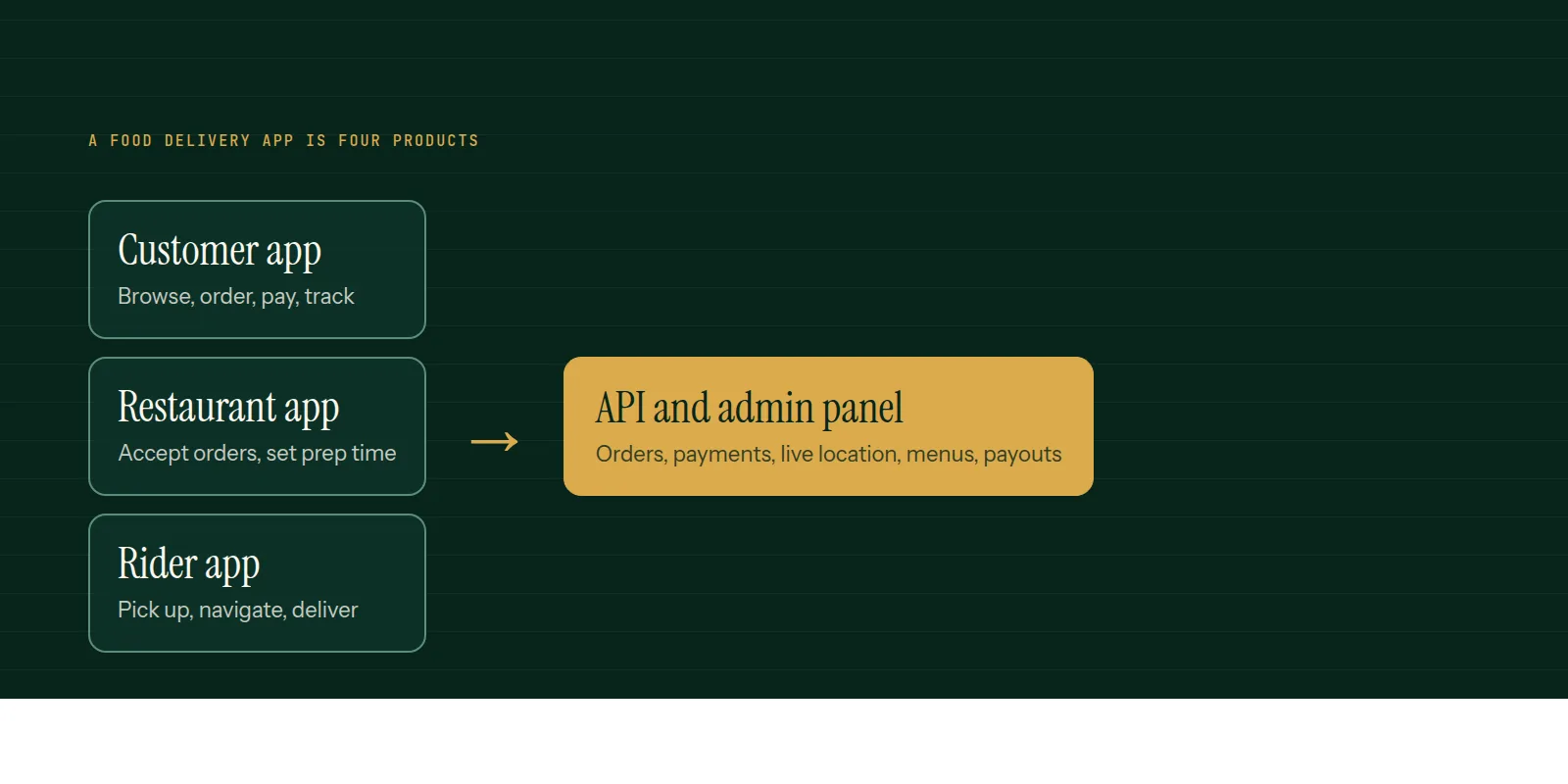
A food delivery app looks simple from the customer's side: pick, pay, wait. Behind that sit a restaurant that must accept the order, a rider who must be assigned, and an operator who must step in when something breaks.
The four products
- Customer app: browse menus, build a cart, pay, track the order.
- Restaurant app or dashboard: receive orders, accept or reject, set preparation time, mark ready.
- Rider app: receive a job, navigate, pick up, hand over, report problems.
- Admin panel: manage restaurants, menus, riders, refunds, payouts and disputes.
All four read and write the same orders. That makes the API and its order states the heart of the system.
Model the order as a state machine
textplaced -> accepted -> preparing -> ready
      -> picked_up -> delivered
any state -> cancelled (with a reason)
Write down every state and who is allowed to move an order between them. Most delivery bugs are two apps disagreeing about the state of one order.
The parts that need care
- Real-time updates. Use WebSockets or push for order status and rider location, not constant polling.
- Maps and location. Rider tracking drains batteries if done carelessly. Update at sensible intervals.
- Payments. Use an established provider. Handle failed and duplicate payments explicitly.
- Notifications. Each role needs timely alerts, and a missed restaurant alert is a lost order.
- Assignment. Start simple, such as nearest available rider, before building clever matching.
A sensible MVP
One city area, a handful of restaurants, a basic rider flow, and an admin panel that lets you fix problems by hand. Prove that orders flow end to end before adding coupons, ratings, scheduled orders and loyalty.
Our restaurant ordering and mobile app pages describe how we scope this kind of multi-role build.
Common questions
- How many apps does a food delivery service need?
- Typically a customer app, a restaurant app or dashboard, a rider app and an admin panel, all backed by one API.
- Do I need to build my own payment system?
- No. Use an established payment provider and keep card details out of your own servers.
- How do I start small?
- Launch in one area with a few restaurants and your own riders, and handle edge cases manually before automating them.
This is what we do
Work of this kind is Restaurant Ordering Systems and Mobile App Development — the same hands that wrote this.
A guide from the team at RiverPoint Web & App. It describes how we would approach this and makes no measurement claims. If you want to talk it through, get in touch.