



Node.js, Laravel or Next.js: which backend fits a business website or app?
None of the three is the best. Each is the better fit for a different kind of project, and the deciding factors are mostly about people, not performance.
Framework debates online treat this as a contest. For a real project it is a fit question: what are you building, who will maintain it, and where will it run.
This is a guide to that reasoning. It does not contain benchmark claims, because for most business applications the database and the network decide speed long before the framework does.
When Node.js is the better fit
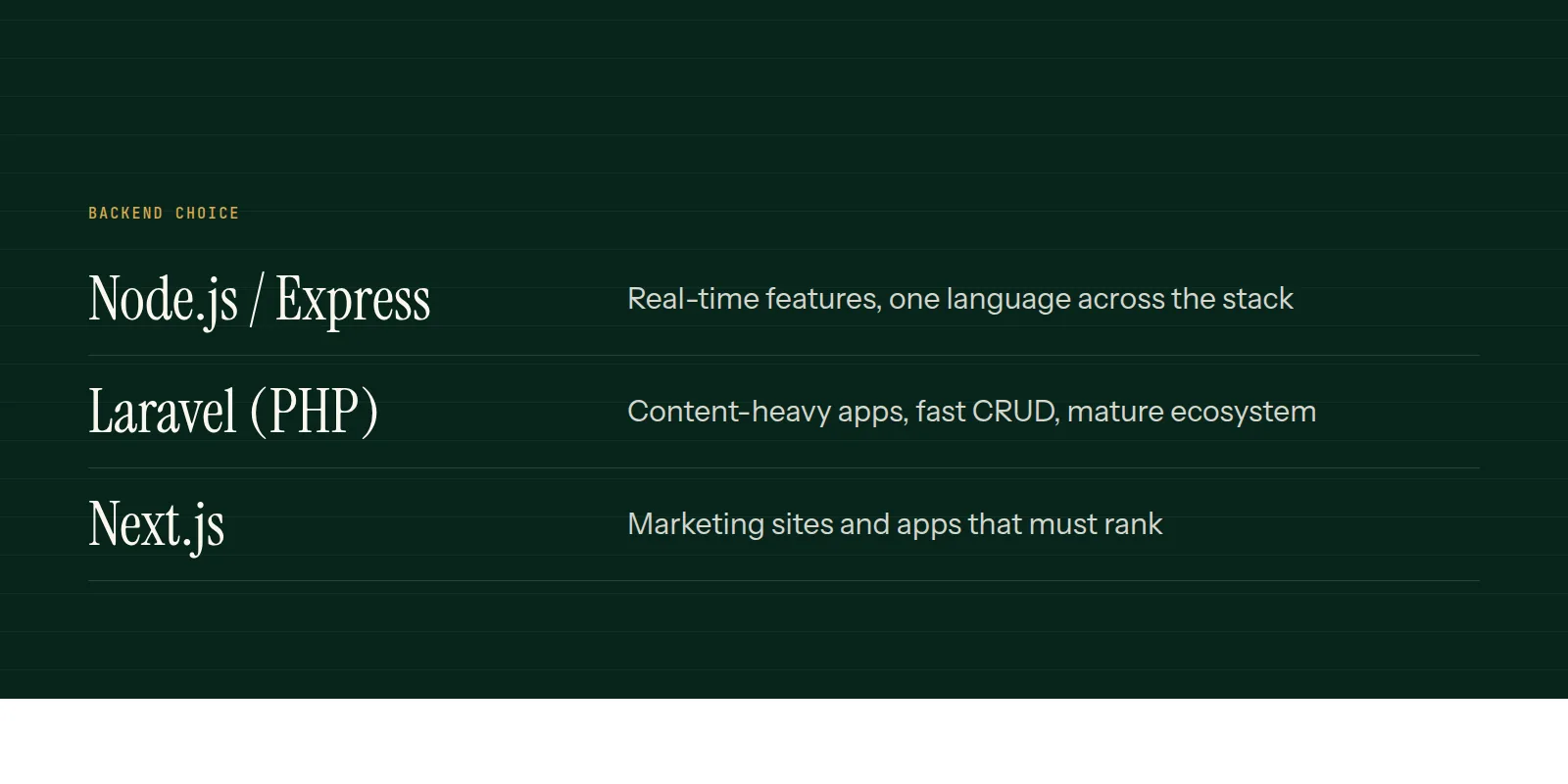
Node.js shines when the product is real-time or event-driven: chat, live dashboards, notifications, WhatsApp or payment webhooks, and anything that holds many connections open. It also lets one team write TypeScript from the browser to the server, which keeps hiring and code sharing simple.
The trade-off is structure. Node gives you freedom, so the quality of the architecture depends on the people building it.
When Laravel is the better fit
Laravel is strong for applications built around data and forms: admin panels, booking systems, portals, internal tools. Authentication, queues, mail, validation and an ORM come ready, so a small team gets to a working product quickly. Shared hosting and low-cost servers also run PHP everywhere.
The trade-off is that real-time features and a rich, app-like front end need extra pieces added around it.
When Next.js is the better fit
Next.js is the choice when the front end is the product and search visibility matters: marketing sites, content sites, shops and SaaS dashboards with public pages. Server rendering and static export give you fast pages that search engines read easily.
The trade-off is that it is a front-end framework first. Heavy background work and complex business rules usually belong in a separate service.
| Node.js | Laravel | Next.js | |
|---|---|---|---|
| Best for | Real-time, APIs, webhooks | Admin tools, portals, CRUD apps | Public sites and SEO-led products |
| Language | TypeScript or JavaScript | PHP | TypeScript, React |
| Comes ready | Little; you assemble it | Auth, queues, mail, ORM | Routing, rendering, image and font tools |
| Main risk | Inconsistent structure | Less natural for real-time | Not a full backend by itself |
A simple way to decide
- Public pages that must rank: start from Next.js.
- Mostly forms, roles and reports behind a login: Laravel gets you there fastest.
- Live updates, many integrations, or a mobile app sharing the same API: Node.js.
- Already have a team: choose what they can maintain confidently.
If you want a second opinion on a specific project, our custom software and developer pages describe how we scope this decision.
Common questions
- Is Laravel still a good choice in 2026?
- Yes. It is mature, well documented and productive for content-heavy and admin-heavy applications, and PHP hosting is widely available and inexpensive.
- Is Next.js a backend?
- It is a React framework with server features such as route handlers and server rendering. For a large API with background jobs, many teams pair it with a separate backend.
- Which is cheapest to maintain?
- The one your team already knows. Maintenance cost follows the size of the hiring pool and how well the code is organised more than the framework itself.
This is what we do
Work of this kind is Hire Node.js Developers, Hire Next.js Developers and Custom Software — the same hands that wrote this.
A guide from the team at RiverPoint Web & App. It describes how we would approach this and makes no measurement claims. If you want to talk it through, get in touch.